Introduction
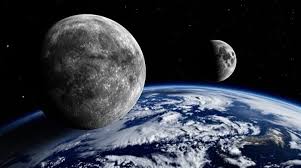
The exploration of our solar system has long fascinated scientists and the general public alike. Among the myriad celestial bodies orbiting planets, Earth has surprisingly been found to have two moons – one being the well-known natural satellite, and the other a temporary capture of asteroids. Recent research by NASA highlights the implications of these two moons on our understanding of the Earth’s formation and space exploration.
What Are Earth’s Two Moons?
Traditionally, Earth is known to have one primary moon, which is the largest natural satellite in the solar system relative to its planet. However, NASA has identified a second, smaller moon, often referred to as 2020 CD3. This object is an asteroid, approximately 1 to 2 metres in diameter, that was caught in Earth’s gravitational pull. It orbits the Earth for a short time before eventually escaping back into space or crashing into the atmosphere.
Recent Discoveries and Research
NASA’s recent observation between February and March 2020 revealed the existence of this temporary moon. Since its discovery, scientists have conducted numerous analyses to understand how these transient moons can give insights into celestial mechanics and the evolutionary history of moons. Increasingly, researchers believe such discoveries might reshape our understanding of how planets acquire natural satellites.
A closer examination of 2020 CD3 has also provided new data on its composition and origin which can help scientists better understand other asteroid bodies within our solar system. The data provided by observing how these moons orbit and interact with Earth can inform future missions and give insights into the history of our planetary system.
Conclusion and Significance
The discovery of Earth’s two moons serves as an exciting reminder of the complexities surrounding our planet and its interactions with space. These findings are not only significant for academic research but also lay the groundwork for potential future explorations and studies, particularly as we engage with the broader cosmos. With continuous advancements in technology and observation methods, further research may uncover even more hidden wonders about our celestial companions.
As NASA continues to make strides in understanding our solar system, these discoveries highlight the dynamic and ever-evolving relationship between Earth and its environment, inspiring future generations of scientists and space enthusiasts alike.