Introduction
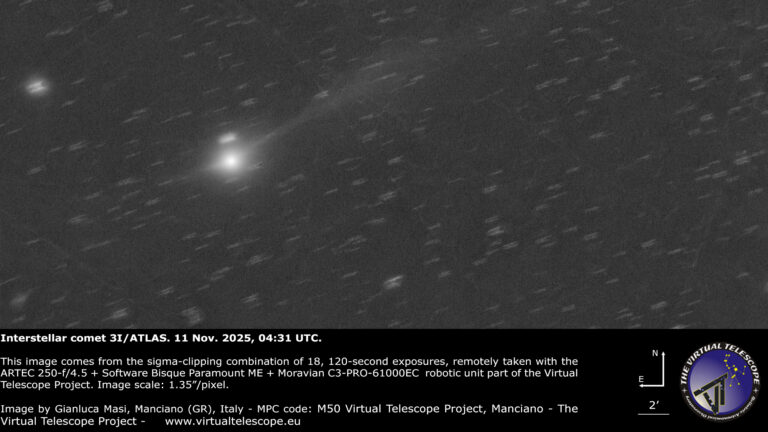
The discovery of interstellar comets offers profound insights into the nature of our universe. The recent identification of interstellar comet 3I ATLAS by NASA has sparked interest among astronomers and space enthusiasts. As the first of its kind discovered in 2023, 3I ATLAS presents a unique opportunity to study objects from beyond our solar system, enhancing our understanding of cosmic formation and evolution.
Details About Comet 3I ATLAS
On October 11, 2023, NASA confirmed the detection of comet 3I ATLAS as a visitor from another star system. It was first spotted by the Asteroid Terrestrial-impact Last Alert System (ATLAS) on September 9, 2023. Following an intensive review by NASA’s Jet Propulsion Laboratory, the comet was classified as interstellar due to its hyperbolic trajectory—indicating it is moving too fast to be captured by the Sun’s gravity.
3I ATLAS is estimated to be approximately 1,000 meters in diameter, making it relatively small compared to other known comets. It is believed to be comprised of rock and ice, typical for comets originating from other star systems. The comet’s approach is being closely monitored, with its closest approach to Earth expected in March 2024, at a distance of roughly 0.15 astronomical units, or about 14 million miles.
Scientific Significance
Interstellar comets like 3I ATLAS are significant to the scientific community as they provide rare samples of material that existed in other star systems. By studying the composition and behaviour of 3I ATLAS, scientists hope to gain insights into the building blocks of planetary systems beyond our own. Furthermore, the comet’s journey and characteristics could reveal information about its home star, which could advance theories of astrophysics and planetary formation.
Future Studies and Observations
NASA and various observatories worldwide are planning multiple observation campaigns to gather data as 3I ATLAS approaches Earth. Instruments equipped with advanced spectroscopy capabilities are expected to analyse the comet’s composition during its flyby. These observations will be crucial in understanding the energetic processes that govern the life cycles of comets, especially those originating from outside our solar neighbourhood.
Conclusion
The interstellar comet 3I ATLAS marks a significant milestone in celestial discovery, emphasizing the increasing possibilities of studying objects from other star systems. As NASA prepares for its close encounter in 2024, the scientific community eagerly anticipates the data that will be gathered from this unique cosmic visitor. The results may not only enhance our understanding of interstellar objects but may also provide critical insights into the origins of our own solar system.