Key moments
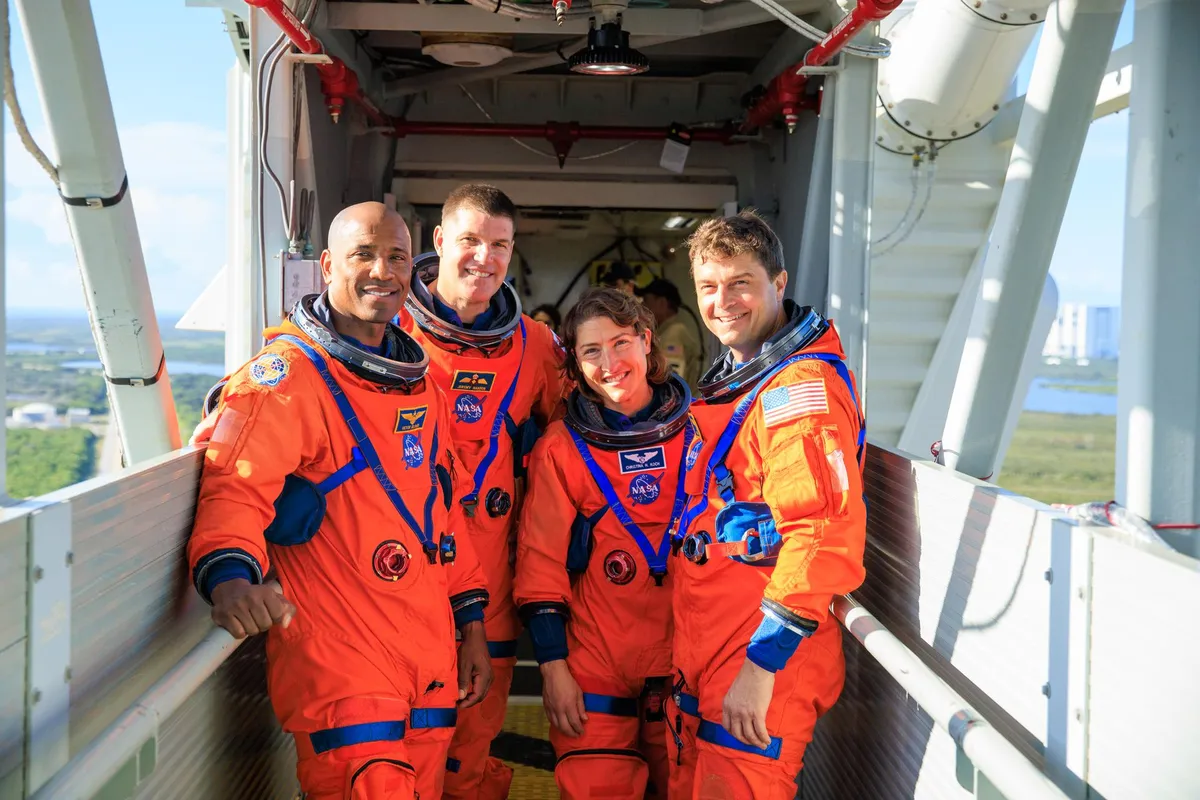
In a momentous announcement from the Kennedy Space Center in Cape Canaveral, Florida, NASA has revealed the crew for its upcoming Artemis II mission, which is set to launch on April 1, 2026. The team includes seasoned astronauts Reid Wiseman, Christina Koch, Victor Glover, and Canadian astronaut Jeremy Hansen. This mission marks a significant milestone as it will be the first time that NASA’s Space Launch System rocket and Orion capsule will carry human passengers into space.
The Artemis II mission is designed as a 10-day journey that will take the crew on a trajectory around the moon, aiming to send them farther from Earth than any human has gone before. This ambitious endeavor seeks to surpass the Apollo 13 distance record of 248,655 miles, pushing the boundaries of human space exploration.
Reid Wiseman will command the mission, with Victor Glover serving as the pilot, while Christina Koch and Jeremy Hansen will take on the roles of mission specialists. Each member of the crew brings a wealth of experience and a unique background to the mission. Notably, Christina Koch holds the record for the longest single spaceflight by a woman, having spent 328 days aboard the International Space Station. Meanwhile, Victor Glover made history as the first Black astronaut to live and work aboard the space station in 2020 and 2021.
As the crew prepares for their journey, they will conduct various science experiments and test critical systems aboard the Orion capsule. The mission will conclude with a splashdown in the Pacific Ocean, marking the end of a journey that aims to inspire a new generation of explorers. “The four of us, we are ready to go. The team is ready to go. The vehicle is ready to go,” said Reid Wiseman, expressing the crew’s enthusiasm and confidence.
Jeremy Hansen, the first Canadian to venture to the moon, shared his excitement about the mission, emphasizing the unifying aspect of lunar exploration. “The moon is like such a unifying thing,” he remarked, highlighting the collaborative spirit of the Artemis program, which aims to bring together nations in the pursuit of knowledge and discovery.
The Artemis II mission is not just a technical achievement; it represents humanity’s first flight to the moon since 1972, rekindling the spirit of exploration that characterized the Apollo era. As the world watches, the Artemis generation will look up at the moon and say, “We are there,” a sentiment echoed by Wiseman as he reflected on the significance of this mission for future generations.
As the countdown to launch begins, NASA is already looking ahead to the Artemis IV mission, which aims to land astronauts on the moon in 2028. This ambitious timeline underscores NASA’s commitment to returning humans to the lunar surface and establishing a sustainable presence there, paving the way for future exploration of Mars and beyond.
With the Artemis II crew poised to make history, the excitement is palpable within the space community and beyond. As they prepare for their journey, the world eagerly anticipates the next chapter in human space exploration, one that promises to inspire and unite people across the globe.