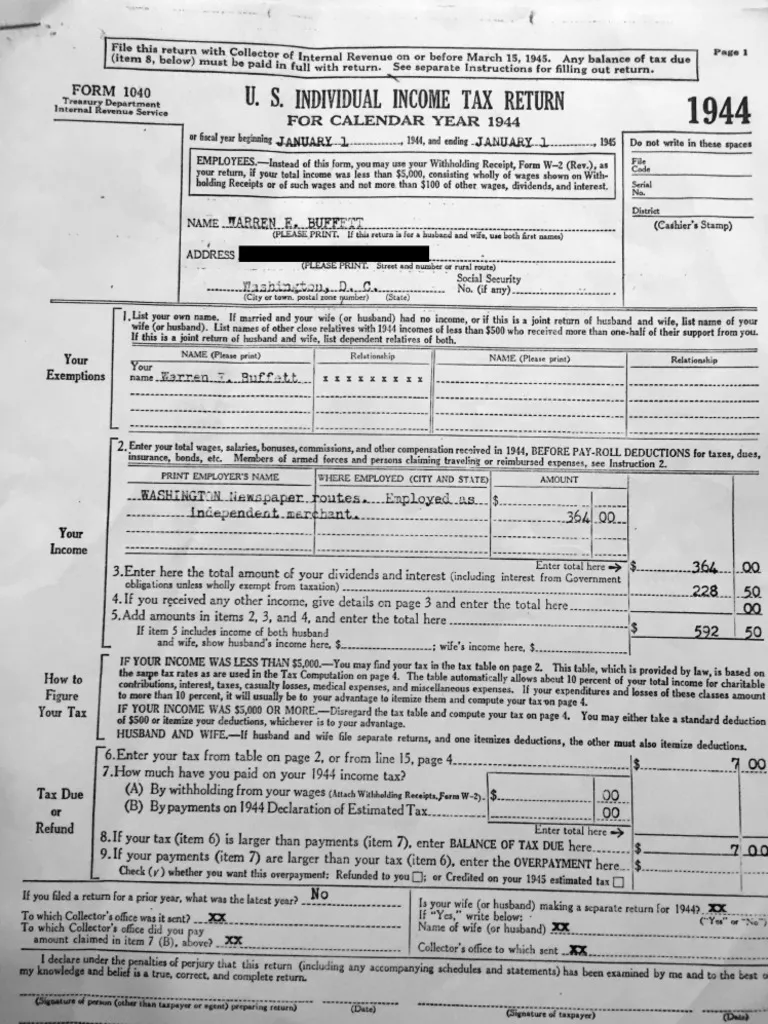
What does Warren Buffett’s first tax return tell us about the financial journey of one of the world’s most renowned investors? Filed on April 14, 1944, when Buffett was just 14 years old, this document marked the beginning of a lifelong commitment to paying taxes. In that year, he owed a mere $7 in federal taxes, a small amount that reflects both his youthful earnings and the simplicity of tax obligations during that time.
In 1944, Buffett earned a total of $592.50, which would be equivalent to approximately $11,244.32 today. His income came from two primary sources: $364 from delivering newspapers and $228.50 from interest and dividends on his early investments. Under IRS rules at the time, any U.S. citizen earning $500 or more was required to file a federal tax return, which Buffett dutifully did.
Interestingly, Buffett’s first tax return included deductions for expenses related to his entrepreneurial activities: $10 for watch repair and $35 for bicycle costs. These small deductions highlight his early understanding of managing finances, a skill that would later serve him well in his illustrious career. Buffett has humorously noted, “I have paid federal income tax every year since 1944. Though, being a slow starter, I owed only $7 in tax that year.” This light-hearted reflection underscores his lifelong dedication to tax compliance.
Buffett’s father, Howard Buffett, was a stockbroker and U.S. Congressman, which likely influenced his early interest in finance and investing. By the age of 11, Buffett had already begun investing, setting the stage for his future success. His early ventures into entrepreneurship, including his paper route, were not just about earning money; they were foundational experiences that shaped his understanding of business and investment.
Fast forward to 2024, and Buffett’s company, Berkshire Hathaway, made headlines by paying $26.8 billion in taxes, the highest-ever payment made to the U.S. government by a single company. This remarkable figure stands in stark contrast to the $7 he owed in 1944, illustrating not only Buffett’s personal growth but also the significant impact of his business on the economy.
Buffett’s story is a testament to the value of hard work and financial responsibility. His early experiences with taxes and investments laid the groundwork for a career that would redefine wealth and philanthropy. As he once remarked, “Debbie works just as hard as I do, and she pays twice the rate I pay. I think that’s outrageous.” This quote reflects his ongoing advocacy for a fairer tax system, emphasizing the disparities that exist within the current framework.
As we reflect on Warren Buffett’s first tax return, we are reminded of the importance of financial literacy and responsibility from a young age. His journey from a paperboy to a financial titan serves as an inspiration for many aspiring entrepreneurs and investors. While much has changed since 1944, the principles of hard work, diligence, and ethical financial practices remain timeless.
Looking ahead, it will be interesting to see how Buffett continues to influence the financial landscape and advocate for equitable tax policies. His story is far from over, and the lessons learned from his early years continue to resonate with individuals and businesses alike.