The wider picture
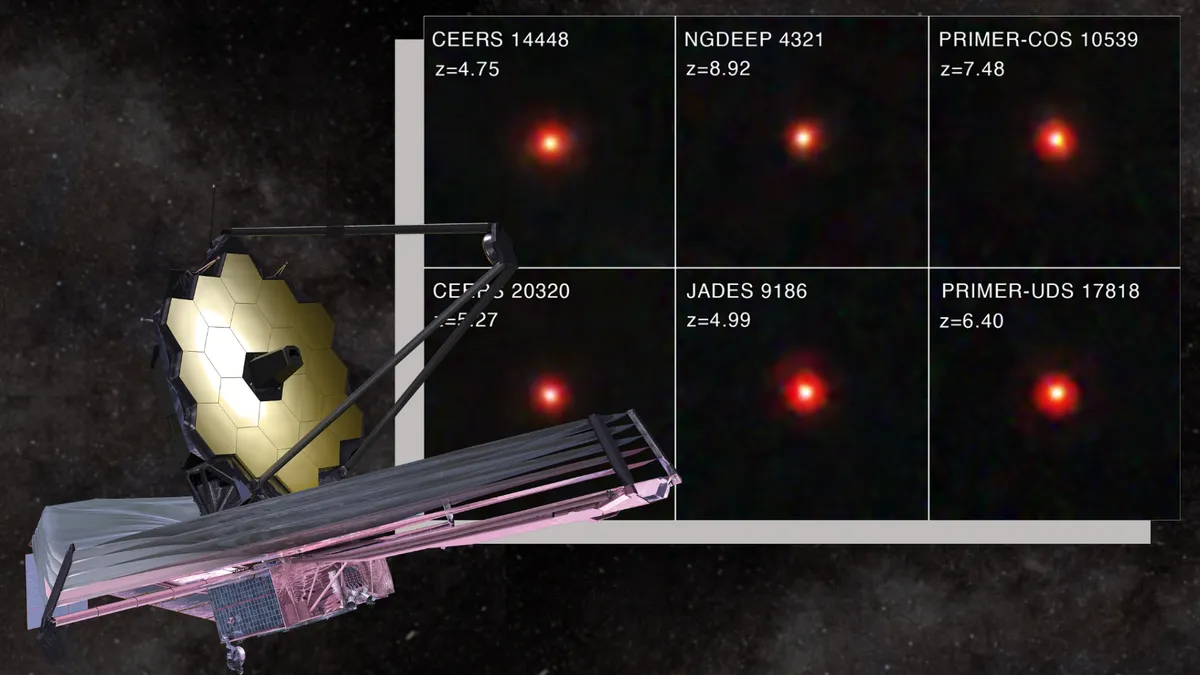
The James Webb Space Telescope (JWST) has been delivering groundbreaking observations that challenge existing theories about cosmic structures and planetary atmospheres. Among its recent discoveries are mysterious objects known as Little Red Dots (LRDs), which have sparked excitement and curiosity within the scientific community. These enigmatic entities are believed to be very distant objects whose light has been stretched to longer wavelengths due to the universe’s expansion, leading to a deeper understanding of the cosmos.
A new hypothesis suggests that these LRDs may not be the black holes that some initially speculated, but rather globular clusters in formation. This idea has generated considerable interest among astronomers, as it could reshape our understanding of how such clusters evolve. The glow of LRDs is thought to come from a young stellar population and possibly a hypothetical Supermassive Star (SMS), further complicating the narrative surrounding these distant objects.
Initial estimates indicate that the number density of LRDs formed across all redshifts is around 0.3 per cubic megaparsec. This finding aligns with the observed redshift range for LRDs, which corresponds with the age distribution of metal-poor globular clusters. However, details remain unconfirmed, and future observations will be crucial in identifying specific chemical abundance patterns to validate the globular cluster hypothesis for LRDs.
In addition to the LRDs, the JWST has made significant strides in exoplanet research. One of its notable discoveries is TOI-561 b, a rocky planet that retains its atmosphere despite extreme conditions. This planet orbits its star in just over 10 hours and has a surface temperature of approximately 3,200 degrees Fahrenheit. Its density is measured at 4.3 grams per cubic centimeter, indicating a volatile-rich gas envelope that challenges previous assumptions about small, intensely irradiated planets.
Researchers have suggested that TOI-561 b maintains a dynamic equilibrium between its magma ocean and atmospheric gases, which could explain why it has not lost its gas envelope early in its life. Tim Lichtenberg, a member of the research team, remarked, “This planet must be much, much more volatile-rich than Earth to explain the observations.” Anjali Piette, another researcher, added, “We really need a thick volatile-rich atmosphere to explain all the observations.” These insights may lead to a reevaluation of how we understand the atmospheres of rocky exoplanets.
The JWST’s findings have the potential to revolutionize our understanding of both cosmic structures and planetary atmospheres. As scientists continue to analyze the data and conduct further observations, the implications of these discoveries will likely resonate throughout the astronomical community. The excitement surrounding the JWST’s capabilities is palpable, as it opens new avenues for exploration and understanding of the universe.
Looking ahead, astronomers are eager to conduct additional observations to confirm the nature of the Little Red Dots and the chemical abundance patterns associated with them. The scientific community is buzzing with anticipation, as these insights could lead to groundbreaking revelations about the formation and evolution of galaxies and stars. With the JWST at the forefront of this exploration, the future of astronomy looks bright.