Introduction
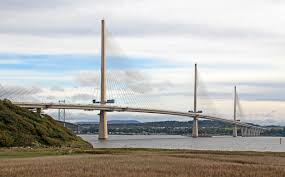
The Queensferry Crossing, which opened to traffic in August 2017, stands as a testament to modern engineering and design, connecting the cities of Edinburgh and Fife over the Firth of Forth. With its impressive scale and innovative construction, this bridge not only enhances transport links but also plays a crucial role in the economic growth of the region. In the face of climate change challenges and the need for resilient infrastructure, the Queensferry Crossing represents a significant advancement in civil engineering.
Design and Construction
Spanning 2.7 kilometres, the Queensferry Crossing was built as a replacement for the ageing Forth Road Bridge. Its design consists of a cable-stayed configuration with three elegant towers, each rising to a height of 210 metres. This architectural choice allows for less interference with navigation on the Firth of Forth while accommodating both vehicle and pedestrian traffic.
The project, costing around £1.35 billion, was built to withstand severe weather conditions, a common occurrence in the region. The construction involved intricate planning and execution, with approximately 2.5 million working hours dedicated to the project, ensuring safety and durability in its structure. It required the work of over 1,000 skilled workers and collaboration with various contractors, highlighting the importance of teamwork in large-scale engineering efforts.
Impact and Significance
Beyond its physical presence, the Queensferry Crossing has significantly improved transport and connectivity for thousands of commuters, easing congestion that had plagued the Forth with a consistent flow of traffic. It offers an estimated saving of £25 million annually in time and operational costs for businesses in the surrounding areas.
Furthermore, the bridge has become a tourist attraction in its own right, drawing visitors eager to experience its grandeur and the scenic views it offers of the Scottish landscape. The completion of the Queensferry Crossing has also rejuvenated local economies, enhancing opportunities for trade and tourism in Edinburgh and beyond.
Conclusion
As we move forward, the Queensferry Crossing is not just an engineering marvel but a vital part of Scotland’s infrastructure that addresses current and future transport demands. Its construction embodies a response to environmental and logistical challenges faced by modern society. The Queensferry Crossing will undoubtedly continue to facilitate growth and connectivity, symbolising progress and innovation in civil engineering for years to come.



